
Artificial intelligence uses advanced technologies such as optical character recognition (OCR) and natural language processing (NLP) to understand and extract important information. Therefore, AI-powered document analysis is a powerful tool for converting unstructured data from any document—such as invoices and contracts—into structured data. Consequently, this data can be integrated directly into CRM and ERP systems, accelerating decision-making and significantly reducing human error.
What Is Unstructured Data, and Why Is It a Challenge?
Unstructured data is information that does not follow a predefined data model. This data includes emails, PDF files, images, and contracts. Conversely, this data makes up about 80% of any organization’s data. The challenge lies in the difficulty of analyzing it and deriving value from it using traditional methods. As a result, many important strategic insights remain hidden within these documents.
How exactly does AI-powered document analysis work?
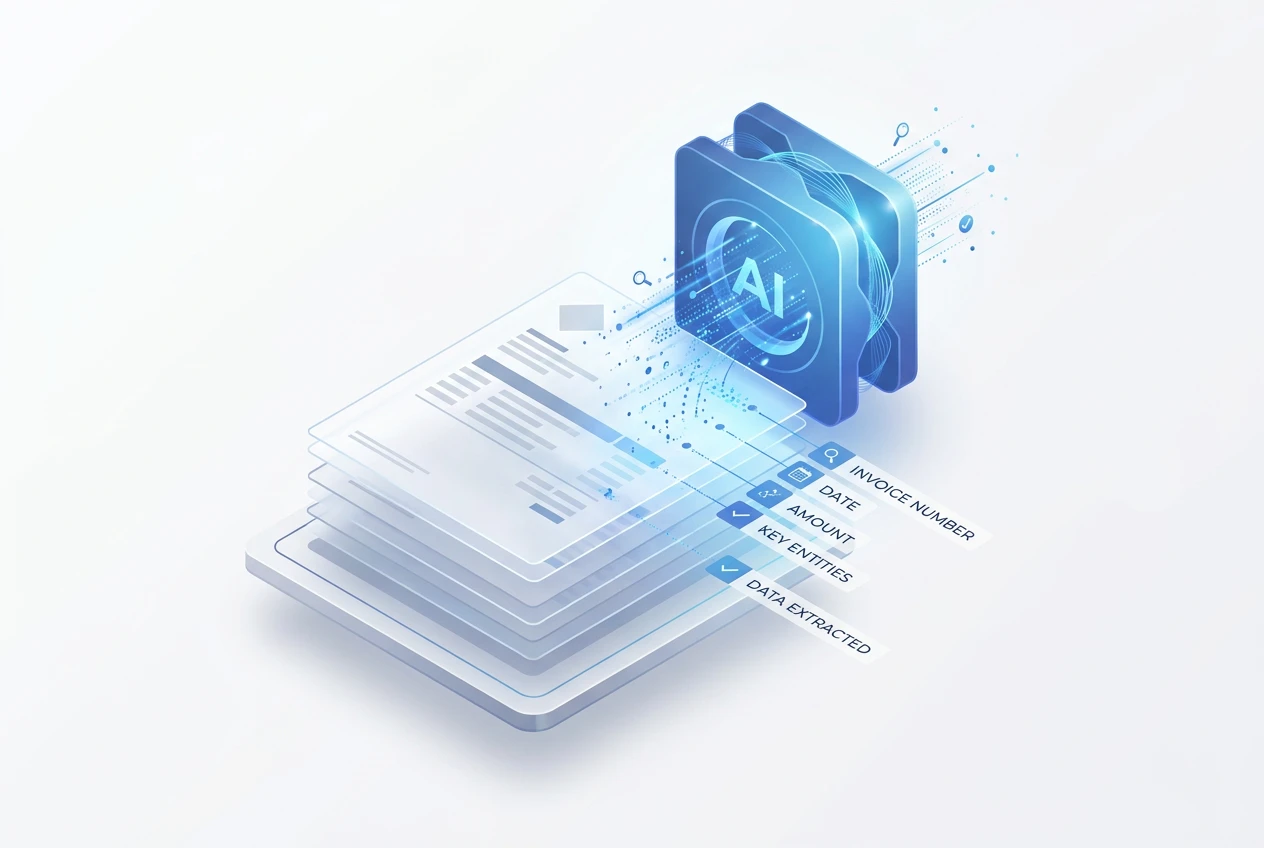
AI-powered document analysis begins by using optical character recognition (OCR) technology to convert images of documents into machine-readable text. Next, natural language processing (NLP) models are used to understand the context of the text. These models identify and extract specific data fields such as invoice numbers, dates, and contractual terms. Finally, this data is organized into tables or JSON files ready for use.
What are the benefits of data entry automation for businesses?
Data entry automation offers tangible benefits. First, it significantly reduces costly human errors. Additionally, it frees employees from repetitive, routine tasks, allowing them to focus on higher-value activities. Furthermore, this automation speeds up business cycles—such as automated invoice processing—which improves cash flow and relationships with suppliers. Consequently, operational efficiency increases significantly.
How does data extraction contribute to decision-making?
Data extraction from documents provides accurate and immediate insights. For example, finance managers can automatically analyze thousands of invoices to identify spending patterns. Legal teams can also quickly review contracts to verify compliance with terms. As a result, decisions are based on comprehensive, up-to-date data rather than guesswork or limited samples. This shift enhances the company’s competitiveness.
What are the most prominent use cases for AI-powered document analysis?
The use cases for this technology are wide-ranging. In the financial sector, it is used to process loan and insurance applications. In the logistics sector, it helps automate shipping invoices and insurance policies. Furthermore, legal departments use this technology to review contracts and agreements. Solutions such as those provided by Law AI offer customized applications for various sectors to ensure maximum benefit.
How is the accuracy of the extracted data ensured?
The accuracy of data extraction depends on the quality of the AI models used. Advanced platforms employ machine learning techniques for continuous improvement. The models are trained on large and diverse datasets. In addition, human verification rules can be added for complex cases or when confidence in the extraction is low. This combination of automation and human oversight ensures accuracy of 99% or higher.
What is the role of integration with ERP and CRM systems?
Integration is key to realizing the full value of document automation. Once data is extracted, it must flow seamlessly into the core systems that manage operations. For example, automatically sending invoice data to an ERP system speeds up the payment process. Similarly, updating the CRM system with information from new contracts improves customer relationship management. Lool AI adopts an integration-first approach to ensure seamless operations.
How can you get started with automating contract and agreement processing?
Getting started with contract processing automation requires clear steps.
- Identify the situation: Start by identifying the most common types of contracts that are time-consuming to process manually.
- Identify Key Data: Identify the essential data fields that need to be extracted, such as party names, important dates, and financial values.
- Choose the Right Solution: Find a technology partner, such as Lowell AI, that can provide a solution tailored to your needs.
- Pilot Project: Conduct a pilot project on a small set of contracts to measure accuracy and return on investment.
- Scaling and Integration: Following a successful pilot, scale the solution to cover all contracts and integrate it with your existing systems.
How is the return on investment (ROI) from this technology measured?
Return on investment (ROI) can be measured through several key metrics. First, calculate the time saved by employees who no longer have to enter data manually. Second, estimate the costs avoided thanks to reduced errors. In addition, you can measure improvements in business cycle speed, such as reducing invoice processing time from days to minutes. Lowell AI combines these metrics to provide clear reports illustrating the tangible financial return from automation.
Frequently Asked Questions
How can artificial intelligence automatically analyze complex documents?
Artificial intelligence uses technologies such as optical character recognition (OCR) to read text and natural language processing (NLP) to understand context and extract key data—such as dates, names, and monetary amounts—with high accuracy.
Can this technology handle handwritten documents?
Yes, advanced OCR models, known as Intelligent Character Recognition (ICR), can recognize handwritten text with varying degrees of accuracy, which is constantly improving as the technology evolves.
What is the difference between OCR and Smart Document Processing?
OCR is a technology for converting images into text only. Smart Document Processing, on the other hand, is an integrated solution that uses OCR as a first step, then adds layers of artificial intelligence to understand, classify, extract, and organize the text.
Are these solutions secure for sensitive documents?
Absolutely. Leading document analysis platforms, such as Lowell AI’s solutions, follow strict security protocols and use end-to-end data encryption to ensure the confidentiality and integrity of all sensitive documents processed.
How long does it take to implement a document automation solution?
Implementation time depends on the complexity of the project. A pilot project can take just a few weeks, while large, end-to-end projects may require several months to ensure seamless integration with all existing systems.
In conclusion, AI-powered document analysis is no longer just a technological luxury—it has become a strategic necessity. Transforming unstructured data into actionable insights gives companies a real competitive advantage. Are you ready to turn your documents into smart decisions? Contact the experts at Lowell AI today. You can also follow the latest news on our page.