
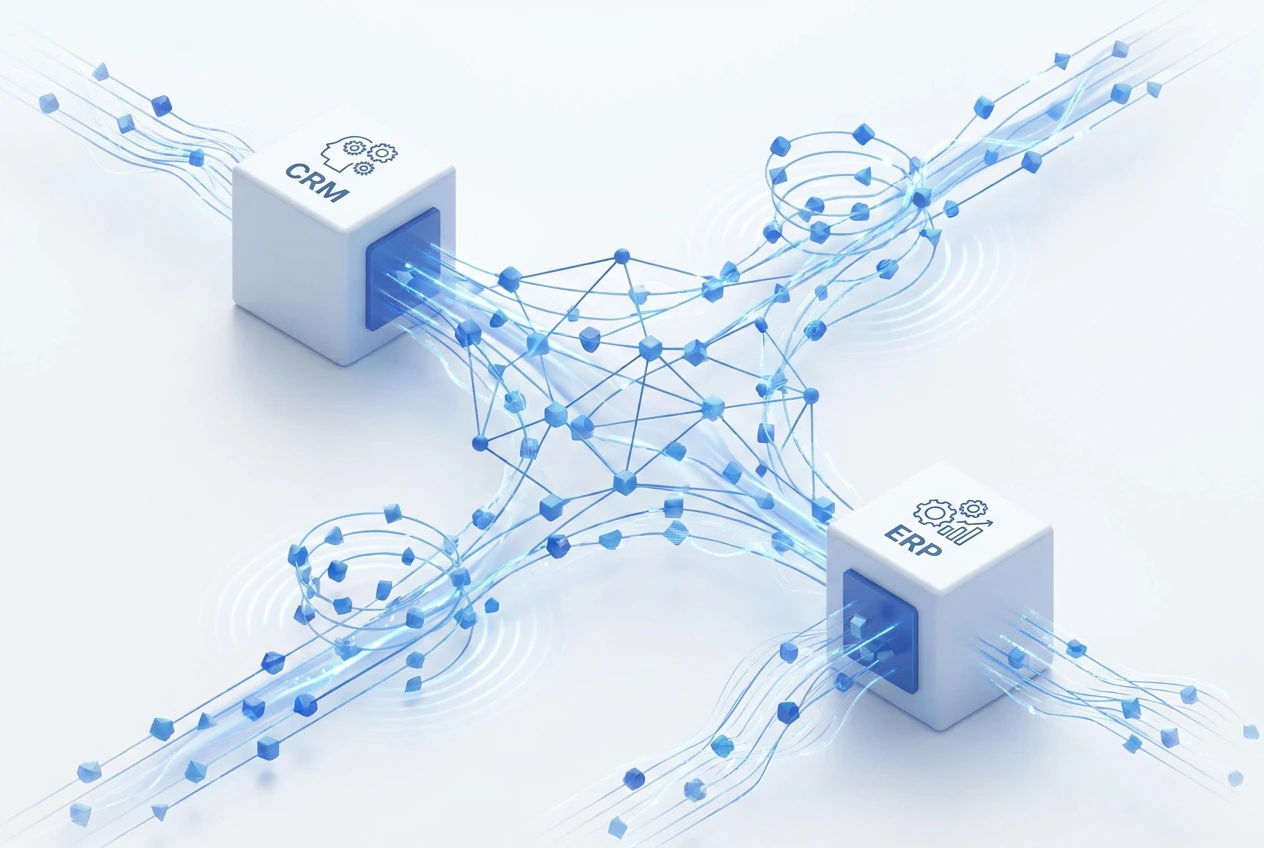
Artificial intelligence creates an intelligent layer to eliminate data silos by connecting your disparate systems, such as CRM, ERP, and accounting. Furthermore, AI agents automatically synchronize data in real time. This ensures a single source of truth and eliminates the need for manual data entry. As a result, reporting accuracy is enhanced, and strategic decision-making is significantly accelerated.
What exactly are data silos?
Data silos are isolated collections of information within an organization. Each department—such as sales or finance—uses its own systems. Consequently, data cannot be easily shared between these departments. For example, a customer relationship management (CRM) system may contain customer information that does not appear in the enterprise resource planning (ERP) system. This disconnect creates multiple, inconsistent versions of the truth, hindering a comprehensive view of the business.
Why Do Data Silos Pose a Threat to Business?
Data silos are a major obstacle to growth. First, they lead to operational inefficiencies, as employees spend time searching for data or manually entering it into multiple systems. In addition, they compromise the accuracy of reports, making strategic decision-making difficult and risky. Conversely, this can negatively impact the customer experience when support teams lack a complete view of past customer interactions. In short, they cost time and money and reduce competitiveness.
How does AI unify data?
AI acts as a smart bridge between disparate systems. Instead of complex manual integration processes, AI solutions create a connectivity layer that understands different data structures. These solutions use advanced algorithms to map and automatically synchronize fields. Therefore, when a customer record is updated in the CRM system, that update is immediately reflected in the accounting and ERP systems. This ensures data consistency across the entire organization.
What role do AI agents play in system synchronization?
AI agents are autonomous programs designed to perform specific tasks. In the context of system synchronization, these agents act as constant monitors of data flow. They monitor changes in one system and then trigger updates in other systems in real time. For example, an AI agent can detect a new invoice in the accounting system and automatically update the order status in the ERP system. This automation reduces human error and ensures operational efficiency.
What are the direct benefits of breaking down data silos?
When you eliminate data silos, you unlock tremendous potential. First, you gain a single source of truth, which significantly enhances the accuracy of reports. Second, productivity increases because employees no longer need to enter data repeatedly. Furthermore, decision-making improves because leaders have a complete and immediate view of business performance. Lo-ol.AI offers solutions that deliver these benefits through its integration-first approach.
How does data unification impact the customer experience?
Data unification leads to a radical transformation in the customer experience. When sales, service, and marketing teams have a unified view of every customer interaction, they can deliver personalized and consistent service. For example, a customer service representative can view a customer’s complete purchase history and resolve issues more quickly. In addition, marketing teams can use unified data to create targeted and effective campaigns. As a result, customer satisfaction and loyalty increase.
What are the first steps toward system synchronization?
The journey toward system synchronization begins with a comprehensive assessment of the current data infrastructure. It’s important to identify the key systems that need to be integrated, such as CRM, ERP, and accounting. Next, you must identify the key data points that need to be synchronized. Companies such as Lo-ol.AI offer strategic consulting to help you develop a clear roadmap. The key steps include the following:
- Identifying core systems (CRM, ERP, Accounting).
- Analyzing current data flows and identifying weaknesses.
- Identifying key business objectives for the integration, such as improving reporting.
- Designing an AI-based integration architecture.
- Implementing AI agent solutions for automatic synchronization.
- Measure return on investment using specific key performance indicators.
How does AI measure the return on investment from integration?
AI provides measurable ways to track return on investment (ROI). Intelligent systems can track the amount of time saved through data entry automation. Additionally, they can analyze improvements in sales forecast accuracy or reductions in billing errors. Lo-ol.AI focuses on delivering tangible ROI through dashboards that clearly display these metrics. As a result, executives can see the direct financial impact of data standardization efforts.
Frequently Asked Questions
What is the difference between data integration and data synchronization?
Data integration is a broader process of combining data from different sources into a unified view. Data synchronization, on the other hand, is a subset of integration and focuses on maintaining data consistency across different systems over time, often in real time.
Are these AI solutions complicated to implement?
Not necessarily. Modern solutions, such as those offered by Lo-ol.AI, rely on a low-code approach. This speeds up the implementation process and reduces reliance on in-house development teams. The goal is to make the integration robust and easy to manage.
How can you connect a CRM to an accounting system using AI?
An AI agent monitors both systems. When a new customer is added to the CRM, the agent creates a corresponding record in the accounting system. Similarly, when an invoice is issued in the accounting system, the agent can update the customer’s record in the CRM with the payment status.
Can these systems handle large amounts of data?
Yes, modern AI platforms are designed to be scalable. They can efficiently process millions of records, ensuring that data synchronization remains fast and reliable even as your business grows.
What kind of support is provided after implementation?
Support typically includes continuous monitoring of the AI agents’ performance, updates to ensure compatibility with new software versions, and technical support to resolve any issues that may arise. The goal is to ensure ongoing operational efficiency.
How do we get started with Lo-ol.AI?
You can start by scheduling a free consultation. During this session, our experts will assess your current systems and discuss your business goals. Afterward, we’ll provide you with a customized roadmap for implementing AI solutions. You can also follow us on Facebook.
Overcoming data silos isn’t just a technical upgrade—it’s a strategic transformation that enables your organization to operate smarter and faster. By leveraging AI to synchronize your critical systems, you can achieve a single source of truth, boost efficiency, and make data-driven decisions with confidence. Start your journey toward a unified data environment today. Discover how our integrated solutions can help you with our services.