
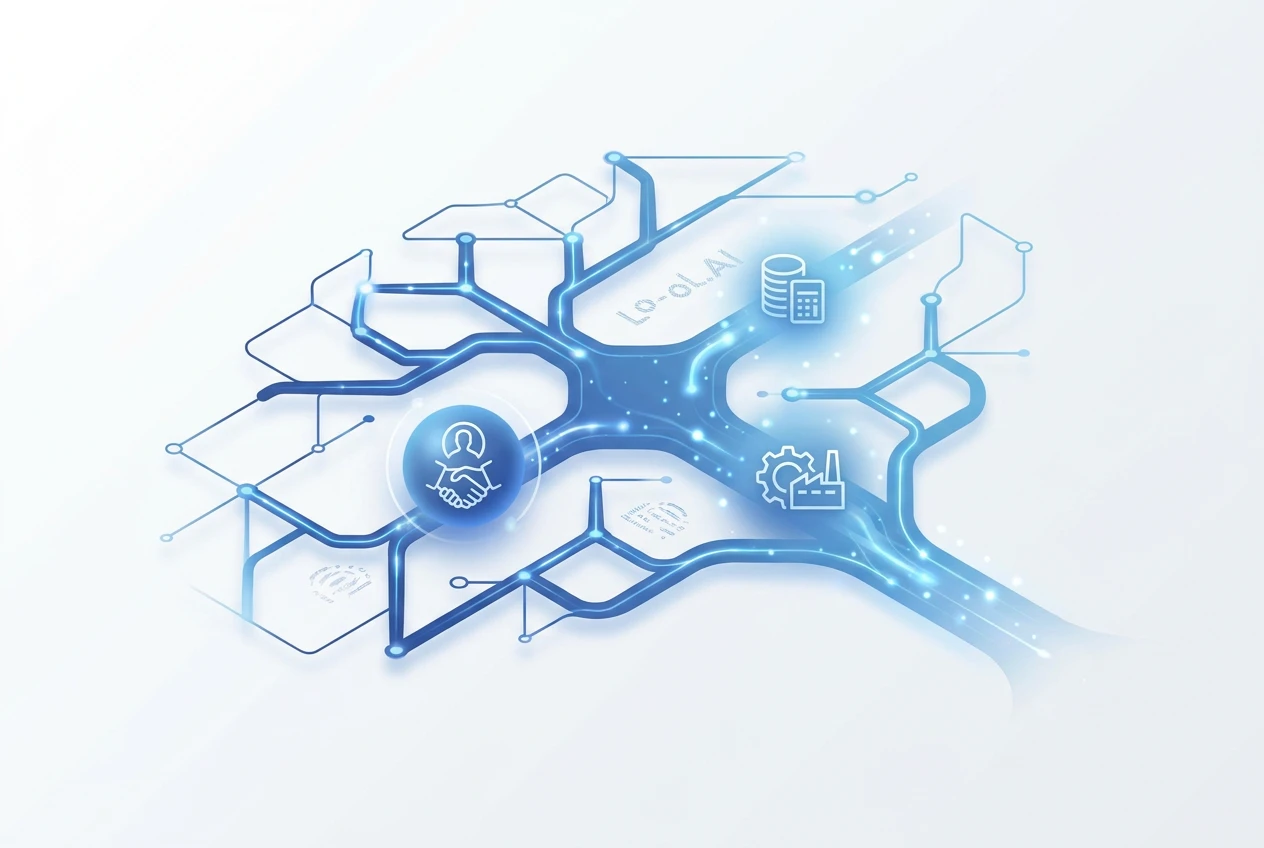
Artificial intelligence acts as a digital nervous system to integrate business data, connecting various systems such as CRM, ERP, and accounting to create a unified and reliable data source. Consequently, it automatically coordinates the flow of information, eliminating manual data entry and reducing errors. As a result, it provides a comprehensive and real-time view of the company’s performance, enabling accurate and rapid strategic decision-making.
What is a digital nervous system for business?
The digital nervous system is a strategic concept that describes an integrated infrastructure. This infrastructure allows information to flow seamlessly across all departments of a company. For example, this system connects sales, finance, operations, and logistics.
In the past, departments operated in isolated data silos. Today, artificial intelligence acts as a central brain that coordinates these systems. Consequently, business data integration becomes possible, creating a unified and comprehensive view of overall performance.
Why is business data integration essential today?
Modern companies face significant challenges due to fragmented data. When customer data is in a CRM system, inventory data is in an ERP system, and billing data is in an accounting system, chaos ensues. Furthermore, manual data entry between these systems leads to costly errors and delays in decision-making.
Therefore, business data integration has become a competitive necessity rather than a luxury. It provides an accurate 360-degree view of customers and operations. As a result, companies can improve forecasting, increase efficiency, and deliver an exceptional customer experience.
How Does Artificial Intelligence Solve Data Integration Challenges?
Artificial intelligence offers radical solutions to traditional integration problems. First, it automates the process of transferring and updating data between different systems. This eliminates the need for human intervention and significantly reduces errors.
In addition, AI can clean and standardize data as it is transferred, ensuring its quality. It also enables the creation of a unified data flow that ensures all departments operate based on the same, real-time information. At Lo-ol.AI, we focus on building these intelligent systems to deliver a tangible return on investment.
What are the benefits of integrating ERP and CRM systems?
Integrating ERP and CRM systems is a critical strategic step. When the two systems are integrated, the sales team gains real-time visibility into inventory levels and order status. In turn, the operations team receives accurate sales forecasts to better plan resources.
This integration creates an efficient information cycle. For example, an invoice can be automatically generated in the accounting system when a deal is closed in the CRM. As a result, operational efficiency increases, errors decrease, and customer relationships improve significantly.
How is a single source of truth built using AI?
Building a single source of truth with AI means creating a centralized and reliable data warehouse. It starts with identifying key data sources such as CRM, ERP, and accounting systems. Next, an AI-powered integration platform is used to pull data from these sources.
AI cleans the data, removes duplicates, and standardizes formats. The data is then stored in a single location accessible to all systems. Consequently, when information is updated in one system, synchronization with other systems is automatically ensured, maintaining data accuracy at all times.
What are the steps for implementing a unified data flow?
Achieving a unified data flow requires careful planning. The process can be summarized in several key steps that ensure the project’s success. Here are the steps we follow at Low AI to help our clients:
- Assessing existing systems: We start by understanding the current infrastructure and identifying data gaps.
- Defining integration goals: We work with you to define desired outcomes, such as reducing report preparation time or improving inventory visibility.
- Selecting an integration platform: We help you choose the right AI-powered tools and technologies.
- Design and develop workflows: We build automated workflows to seamlessly transfer data between systems.
- Testing and Deployment: We thoroughly test the solution to ensure accuracy and reliability before its full launch.
- Monitoring and Continuous Improvement: We monitor system performance and make continuous improvements to ensure maximum benefit.
How does synchronization between systems ensure data accuracy?
Synchronization between systems is the cornerstone of any successful integration strategy. It ensures that any change made in one system is immediately reflected across all connected systems. For example, if a customer updates their address through the self-service portal (which is connected to the CRM), that address is automatically updated in the billing system (ERP).
This real-time synchronization prevents data inconsistencies. As a result, employees make decisions based on information that is always accurate and up-to-date. It also builds customer trust, as they interact with a company that maintains a consistent view of their data.
Frequently Asked Questions
What are the biggest challenges of ERP integration?
Key challenges include high costs, the complexity of legacy systems, employee resistance to change, and ensuring data security during transfer. Overcoming these challenges requires an expert technology partner such as Lo-ol.AI.
How can accounting data be effectively linked with customer data?
This is done through an integration platform that links data fields between the accounting system and the CRM system. For example, a customer’s record in the CRM is linked to their account in the accounting system, allowing payment and invoice records to be synchronized automatically.
Can small businesses benefit from the digital nervous system?
Yes, absolutely. Cloud-based and AI-powered integration solutions are now widely available and affordable. Small businesses can achieve significant gains in efficiency and growth by connecting their core systems, such as accounting software and CRM.
What is the difference between data integration and data synchronization?
Data integration is the broader process of connecting different systems so they work together. Data synchronization, on the other hand, is a subset of integration that focuses specifically on keeping data up to date and consistent across these connected systems in real time.
How long does a systems integration project take?
The time required depends on the complexity and number of systems, as well as the project’s objectives. Simple projects can take a few weeks, while large and complex projects may require several months. Good planning significantly speeds up the process.
In conclusion, business data integration is no longer just a technical option; it is a strategic foundation for building a flexible and responsive company. The digital nervous system, powered by artificial intelligence, represents the future of efficient and intelligent business management. Are you ready to build a single source of truth for your company? Contact the experts at Lowell AI today. You can follow our latest news on Facebook.