
Smart solution engines go beyond traditional text-based responses. They connect to customer relationship management (CRM) and enterprise resource planning (ERP) systems to diagnose complex issues. In addition, these engines take concrete actions to resolve them, such as updating an order status or processing a refund. This shift from mere response to actual resolution reduces the number of issues escalated to human agents and dramatically boosts customer satisfaction.
What exactly are intelligent solution engines?
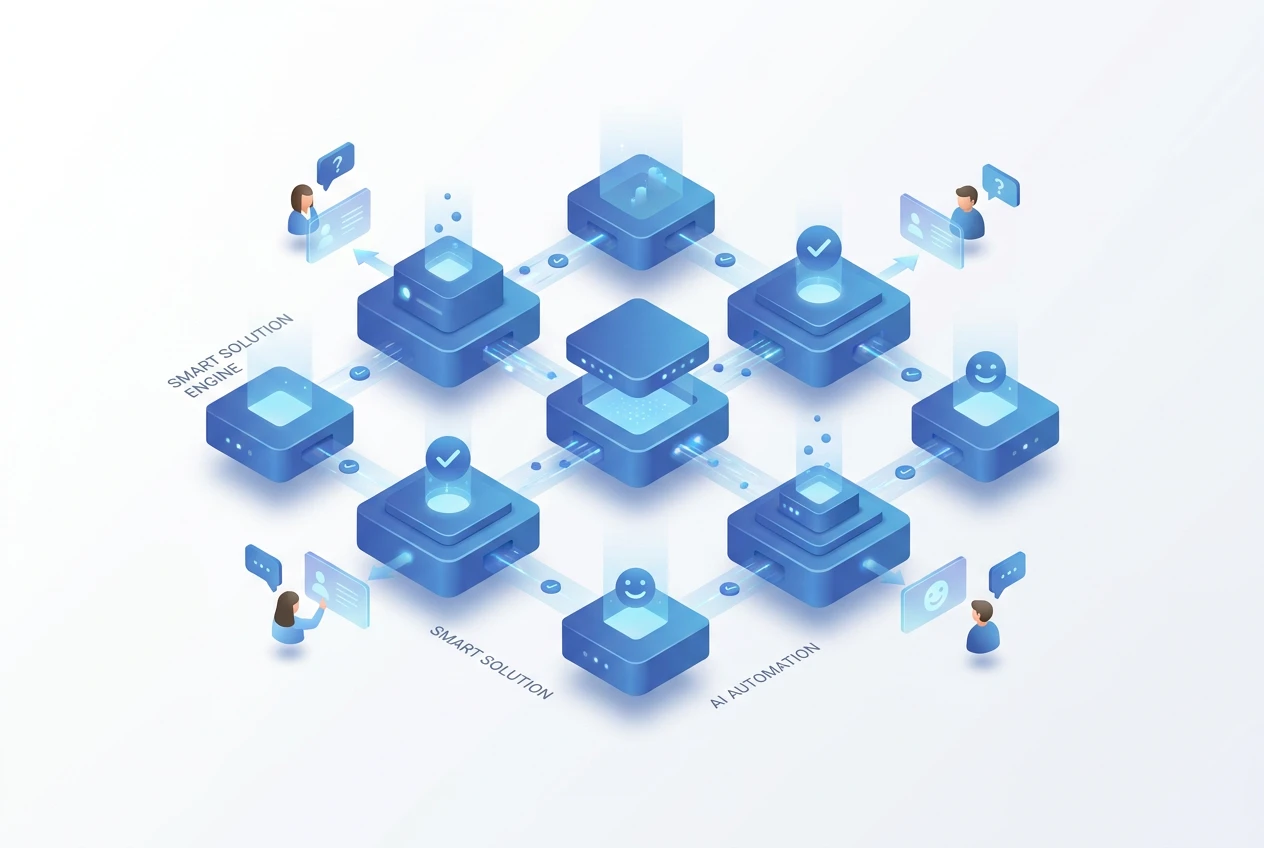
Smart solution engines are advanced artificial intelligence systems designed to independently understand and resolve complex customer inquiries. Unlike simple chatbots that follow predefined scripts, these engines use machine learning and natural language processing to analyze intent and context. As a result, they can interact with databases and back-end systems to perform real tasks. They represent the next step in the evolution of customer service automation, moving from providing information to taking action.
How do they differ from traditional chatbots?
The key difference lies in their ability to take action. Traditional chatbots are adept at answering frequently asked questions or guiding users. In contrast, smart solution engines go a step further. They integrate deeply with your business systems. For example, they can verify warranty details, reschedule a delivery, or apply a credit to a customer’s account. This means they don’t just answer the question “Where’s my order?”—they can also identify the problem and resolve it if the order is delayed.
What role does integration with back-end systems play?
Integration is the heart and soul of smart solution engines. Without access to critical systems such as CRM, ERP, and inventory, artificial intelligence is merely an informational interface. Integration allows the solution engine to gain a comprehensive view of customer data, order history, and past issues. Consequently, it can make informed decisions and implement precise solutions. Companies such as Lo-ol.AI adopt an “integration-first” approach, ensuring that AI solutions are effective and impactful from day one.
What kinds of complex problems can these engines solve?
Smart solution engines excel at handling scenarios that require multiple steps or verifying data across different systems. They can handle issues such as “I received the wrong product and want to exchange it” or “I was charged twice for my last order.” In these cases, the engine verifies the order, confirms payment details, checks inventory for the correct product, and automatically initiates the return and exchange process. This frees up human agents to focus on issues that require empathy or exceptional judgment.
How do smart solution engines help improve the customer experience?
These engines significantly improve the customer experience by providing immediate and accurate solutions 24/7. Customers don’t have to wait in support queues or repeat their issue to multiple agents. Furthermore, receiving an immediate solution rather than just an answer builds trust and brand loyalty. When customers feel that their issues are being resolved efficiently and quickly, their satisfaction increases significantly. This directly leads to improved customer retention rates and increased lifetime value.
What are the benefits of an autonomous technical support application?
Implementing self-service technical support using intelligent solution engines offers strategic benefits that go beyond mere cost reduction. First, it significantly reduces the volume of tickets reaching the human support team, allowing them to focus on higher-value tasks. Second, it provides valuable data and insights into common customer pain points. Third, it ensures a consistent, high-quality service experience. In short, it’s an investment in both operational efficiency and customer satisfaction, leading to a measurable return on investment—which is what Lo-ol.AI specializes in.
What are the steps to building an AI solutions engine?
Building an effective solution engine requires strategic planning and technical expertise. The process typically begins by identifying the most impactful use cases that can be automated. Here are the key steps:
- Define objectives: Identify the specific processes to be automated, such as handling returns or account updates.
- Collect data: Compile and analyze historical support records to understand how customers phrase their questions and the paths that lead to a resolution.
- Selecting a platform: Choose an AI partner, such as Lo-ol.AI, that offers robust integration capabilities and pre-trained models.
- System Integration: Connect the AI engine to the application programming interfaces (APIs) of your CRM, ERP, and other relevant systems.
- Training and testing: Train the model on your specific data and test it thoroughly to ensure accuracy and reliability.
- Deployment and Monitoring: Roll out the engine gradually and continuously monitor its performance to improve and scale it over time.
How can you measure the return on investment (ROI) from customer service automation?
ROI is measured through a set of quantitative and qualitative metrics. Quantitative metrics include a reduction in the cost of service per interaction, a decrease in average handling time, and an increase in the first-time resolution rate. In addition, track the reduction in the number of tickets escalated to human agents. On the qualitative side, the impact can be measured through customer satisfaction surveys (CSAT) and Net Promoter Score (NPS). Together, these metrics ensure that automation not only improves efficiency but also enhances the customer experience.
Frequently Asked Questions
What is the main difference between generative AI and solution engines?
Generative AI focuses on creating new, human-like content, such as text and images. Solution engines, on the other hand, focus on understanding context and taking specific actions within business systems to solve a problem. A solution engine can use generative AI to improve its conversations, but its primary goal is execution, not just generation.
Can these engines handle all customer inquiries?
No, and they are not designed to do so. Intelligent solution engines excel at handling process-based tasks that can be identified and resolved through data and specific procedures. Issues that require deep empathy, creative problem-solving, or complex negotiations are still best handled by human agents.
How difficult is it to integrate a solution engine with my existing systems?
The difficulty depends on how modern your systems are and whether they provide application programming interfaces (APIs). Specialized companies such as Lo-ol.AI are working to simplify this process through pre-built connectors and an “integration-first” approach. The bulk of the work lies in initial strategic planning and process mapping.
Does autonomous technical support replace a human customer service team?
No, it enhances it. By automating repetitive and complex but process-driven inquiries, intelligent solution engines free up human agents to focus on building relationships with customers and solving more complex problems. This transforms the role of the customer service agent from a task executor to a strategic advisor.
How long does it take to see tangible results?
Initial results, such as a reduction in ticket volume, can be seen within a few weeks of implementation. However, the full benefits—including significant improvements in customer satisfaction and return on investment—typically emerge within 3 to 6 months as the system is optimized and its capabilities expanded. Follow us on Facebook for more insights.
The transition to intelligent solution engines represents a critical evolution in customer service. It transforms support from a cost center into a strategic driver of growth and customer satisfaction. By automating the resolution of complex issues, companies can deliver exceptional experiences while improving operational efficiency. If you’re ready to move beyond basic chatbots and implement AI that delivers real results, explore our services at Lo-ol.AI today.