
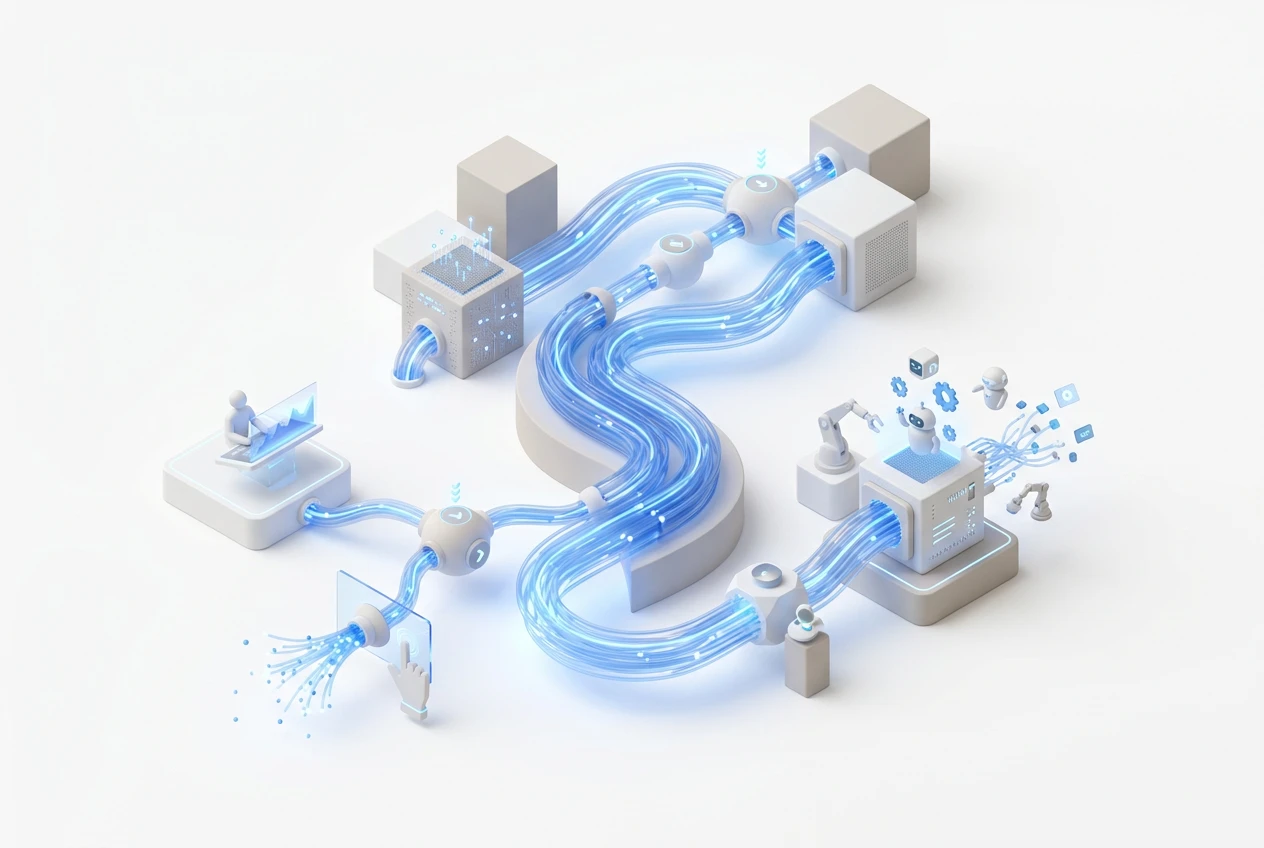
Artificial intelligence creates a “business knowledge fabric” that connects your various systems, such as customer relationship management and accounting. This integration enables data to flow seamlessly, allowing complex cross-departmental processes to be executed simultaneously. Consequently, it gives you a comprehensive and real-time view to improve decision-making and significantly accelerate operational growth.
What exactly is a business knowledge fabric?
A knowledge fabric is an intelligent infrastructure that acts as a bridge between all data sources and applications in your company. Instead of having separate systems that don’t communicate with one another, artificial intelligence understands, categorizes, and connects information from each system. As a result, it creates a unified knowledge network that can be accessed and used by any department, eliminating information silos.
Why do traditional methods fail to connect systems?
Traditional methods often rely on custom application programming interfaces (APIs) or manual data entry. These solutions are fragile, costly, and time-consuming. Furthermore, when one system is updated, the connection may be disrupted, requiring constant intervention. In contrast, the knowledge fabric offers greater flexibility and the ability to adapt to changes automatically.
How does artificial intelligence build this fabric?
AI uses advanced technologies such as natural language processing and machine learning to understand the context of the data. First, it collects data from various sources such as emails, databases, and documents. It then analyzes this data and links similar concepts together, even if they are stored in different systems. In this way, it builds a dynamic map of the company’s knowledge.
What are the benefits of a unified operational view?
When all your data is connected, you gain a complete and real-time operational view. You can track the customer journey from the first marketing touchpoint to post-sales support in a single dashboard. As a result, decision-making becomes faster and more informed, as it’s based on comprehensive, up-to-date data. This visibility allows you to identify issues before they escalate and quickly discover new opportunities.
Can a knowledge graph drive accelerated growth?
Absolutely. Accelerated growth depends on efficiency and speed in decision-making. A knowledge graph allows you to automate complex processes that span multiple departments, reducing human error and saving time. For example, a new purchase order can automatically trigger an inventory update, generate an invoice, and send a shipping notification—all in an instant and without manual intervention.
Practical Example: Streamlining Processes with Artificial Intelligence
Imagine an e-commerce company that uses one system for customer relationship management (CRM), another for inventory, and a third for accounting. Without a knowledge graph, employees must manually transfer data. But with a knowledge graph, when a customer returns a product, the AI agent automatically updates inventory, issues a credit memo in the accounting system, and alerts the customer service team. This is system integration at its best.
How do you start building a smart infrastructure for your business?
Getting started doesn’t require completely overhauling your existing infrastructure. Instead, you can begin by identifying a key process that suffers from inefficiencies due to siloed systems. From there, you can work with a specialized partner like Lo-ol.AI to design and implement an AI solution that connects these systems. Our services offer an integrated approach that ensures a measurable return on investment from automation.
What role do AI agents play in this framework?
AI agents are the operational tools that function within the cognitive fabric. They are not just chatbots; they are strategic digital workers. These agents execute tasks, monitor operations, provide analytics, and interact with various systems on your behalf. At Lo-ol.AI, we specialize in building these intelligent agents that transform interconnected data into effective actions.
Frequently Asked Questions
What is the difference between a knowledge graph and traditional data integration?
Traditional data integration focuses on moving data from point A to point B. In contrast, a knowledge graph understands the context of the data and creates a dynamic network of relationships between them, enabling smarter automation.
Do I need to replace my current systems?
Not at all. The knowledge graph is designed to work on top of your existing infrastructure. It connects your systems together rather than replacing them, preserving your technology investments.
How long does it take to build a knowledge fabric?
That depends on the size and complexity of your operations. However, you can start with a small pilot project within weeks to quickly demonstrate value, and then scale up gradually.
Is this solution suitable for small and medium-sized businesses?
Yes. Thanks to cloud-based solutions, artificial intelligence and the knowledge fabric are now accessible to companies of all sizes, not just large enterprises. It provides a strong competitive advantage.
How can I measure the return on investment?
ROI is measured by time savings, reduced errors, faster operations, and improved customer satisfaction. At Lo-ol.AI, we help you define and track your key performance indicators.
Are you ready to transform your siloed operations into an integrated growth engine? The future of business lies in the ability to connect everything. Start building your business’s knowledge fabric with us today. Contact us to learn how Lo-ol.AI’s strategic AI agents can unify your business. Follow us on Facebook to stay up to date on the latest developments.