
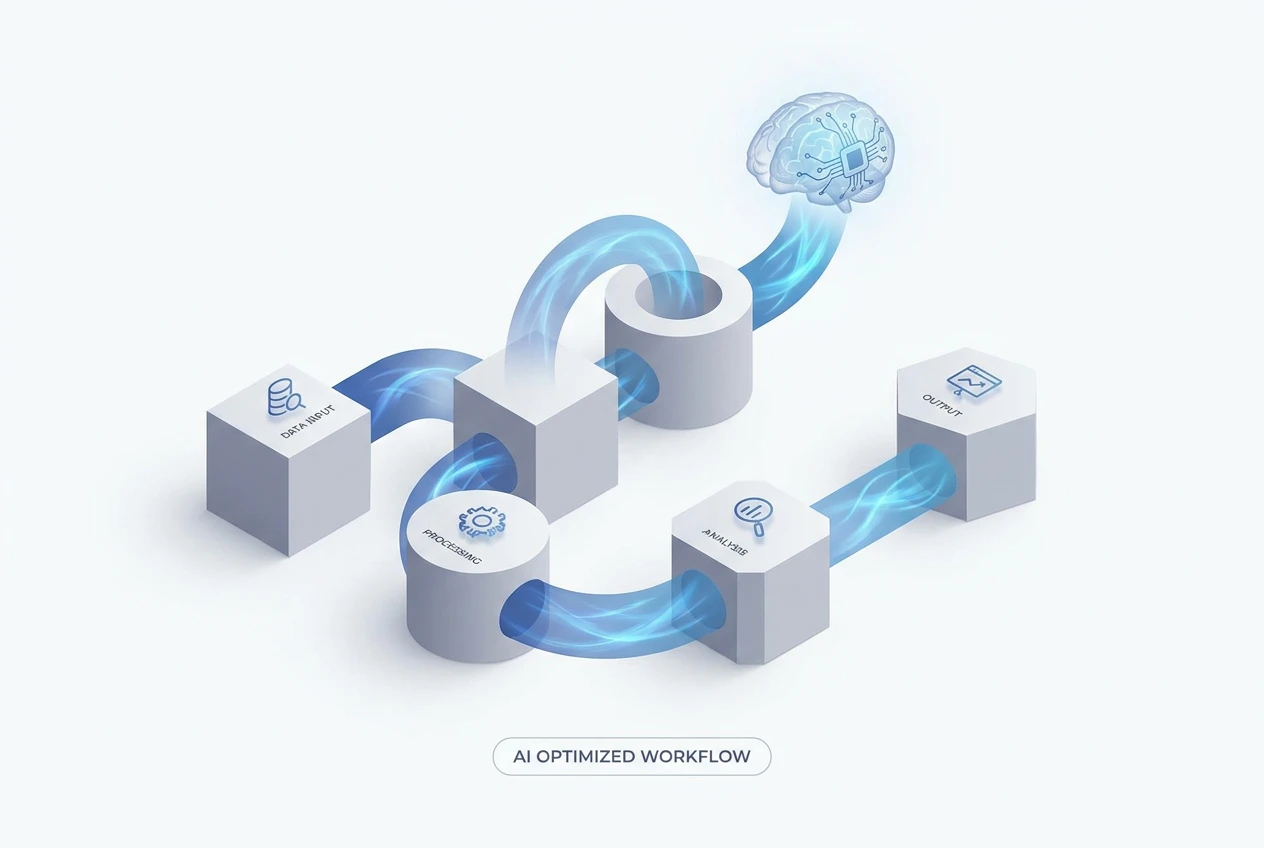
Artificial intelligence acts as a central coordinator, connecting systems such as CRM, ERP, and accounting via application programming interfaces (APIs). It creates intelligent workflows that automatically transfer data and trigger actions across departments. This AI-driven approach to process orchestration eliminates manual data entry and unifies operational processes to achieve unprecedented efficiency. As a result, your company gains a unified and robust operational view.
What exactly is AI-driven process orchestration?
AI-driven process orchestration is the use of AI technologies to connect and direct business processes across multiple systems and applications. Instead of siloed departments, AI builds digital bridges. For example, when a deal is closed in a CRM system, AI can automatically trigger the invoicing process in the accounting system. This approach acts as a central nervous system, ensuring that information and actions flow seamlessly. It represents a significant advancement over simple automation, adding a layer of intelligence and decision-making capability.
Why is system integration so vital today?
In the modern business environment, companies rely on a variety of specialized software. The sales department uses a CRM system, while the finance department uses an ERP system, and the marketing department uses its own tools. Without effective integration, these systems become isolated islands of data. As a result, errors occur due to repetitive manual data entry, and a lot of time is wasted. Integrating these systems—known as business logic automation—unifies data and creates a single source of truth, which enhances the accuracy of reports and speeds up decision-making.
How do smart workflows work in practice?
Smart workflows operate by predefining triggers and actions. A trigger is a specific event, such as receiving an email from a key client. An action is the task that is performed automatically, such as creating a support ticket and assigning it to the appropriate employee. In addition, artificial intelligence can analyze the content of the email to determine the urgency of the issue. Thus, these workflows go beyond simple automation to become proactive, intelligent processes that adapt to the business context.
What are the benefits of AI-driven process automation for businesses?
The benefits are numerous, but the most notable is the achievement of operational efficiency. First, automation significantly reduces human error, thereby improving data quality. Second, it frees up valuable employee time that can be spent on strategic tasks rather than repetitive ones. Furthermore, it accelerates business cycles—from sales to collections—thereby improving cash flow. Ultimately, it gives you a comprehensive and real-time view of the company’s performance, making it easier to identify weaknesses and opportunities for improvement.
Can any company implement AI-driven process automation?
Yes, companies of various sizes and across different industries can benefit from this approach. However, success depends on having a solid digital infrastructure in place. A company needs existing systems (such as CRM or ERP) and clarity regarding its current processes. The process typically begins by identifying the most repetitive and time-consuming processes. From there, customized automation solutions can be built. At Lo-ol.AI, we take an integration-first approach, ensuring that our solutions work seamlessly with your existing systems.
What is the difference between process orchestration and traditional automation?
Traditional automation (RPA) focuses on simulating repetitive human actions within a single application. For example, copying data from a spreadsheet and pasting it into another system. In contrast, AI-powered process orchestration goes much further. It connects multiple systems and makes decisions based on business logic. It doesn’t just mimic clicks; it understands the context of the data and coordinates complex workflows across different departments. Therefore, orchestration is considered a strategic evolution of automation.
How are CRM and ERP systems integrated using AI?
CRM and ERP systems are primarily connected via application programming interfaces (APIs). AI acts as an intelligent intermediary between these two systems. For example, an intelligent workflow can be built that does the following:
- When a prospect’s status is updated to “closed deal” in the CRM, AI automatically creates a new customer record in the ERP system.
- It then transfers the order details from the CRM to the ERP to create a sales order.
- Finally, it sends a notification to the accounting department to initiate the invoicing process.
This integration ensures that sales and financial data are always in sync without manual intervention.
What is the strategic role of AI in operations?
The role of artificial intelligence goes beyond mere operational efficiency to reach a strategic level. By analyzing data flowing through interconnected systems, AI can identify patterns and trends that humans might overlook. For example, it can predict which customers are at risk of churning or identify supply chain bottlenecks before they occur. Thus, AI becomes a strategic partner that helps leaders make proactive, data-driven decisions—not just a tool for saving time.
How do I start building an integrated operations system?
Start with a comprehensive assessment of your current operations. Identify the most repetitive and error-prone tasks. Start with a small pilot project that has a clear impact, such as automating the workflow between sales and accounting. This allows you to prove the concept and measure the return on investment. It’s essential to choose a technology partner who understands both AI and your business goals. At Lo-ol.AI, we help companies develop a comprehensive implementation strategy, from assessment through full implementation to measuring results.
Frequently Asked Questions
What are Application Programming Interfaces (APIs)?
Application Programming Interfaces (APIs) are a set of rules and protocols that allow different software applications to communicate with one another. They act as a “translator” that enables a CRM system to “talk” to an ERP system and securely share data.
Is AI-driven process automation expensive?
The initial cost depends on the complexity of your processes. However, the return on investment is often significant and rapid. This return comes in the form of saved labor hours, reduced costly errors, and accelerated revenue cycles.
How long does it take to implement an AI-powered workflow?
Simple workflows can be implemented within days or weeks. More complex projects involving the integration of multiple systems may take longer. The timeline depends on the clarity of the requirements and the quality of the existing systems.
Do I need an in-house technical team to implement this?
Not necessarily. Specialized partners such as Lo-ol.AI can handle the entire technical implementation. Your role as an operations manager is to define the business goals and identify the processes that need improvement.
What are the security risks associated with integrating systems?
Security is a top priority. Data transfers via application programming interfaces (APIs) are secured using encryption and strong authentication protocols. Working with a trusted partner ensures that your data is handled in accordance with security best practices.
Transforming your company into a connected, intelligent entity is no longer an option—it’s a competitive necessity. AI-driven process orchestration represents the next step in the evolution of operational efficiency. If you’re ready to build a neural network for your company and achieve measurable returns from automation, our team at Lo-ol.AI is ready to help you. Explore our AI automation services today. You can also follow our latest insights on our page.