
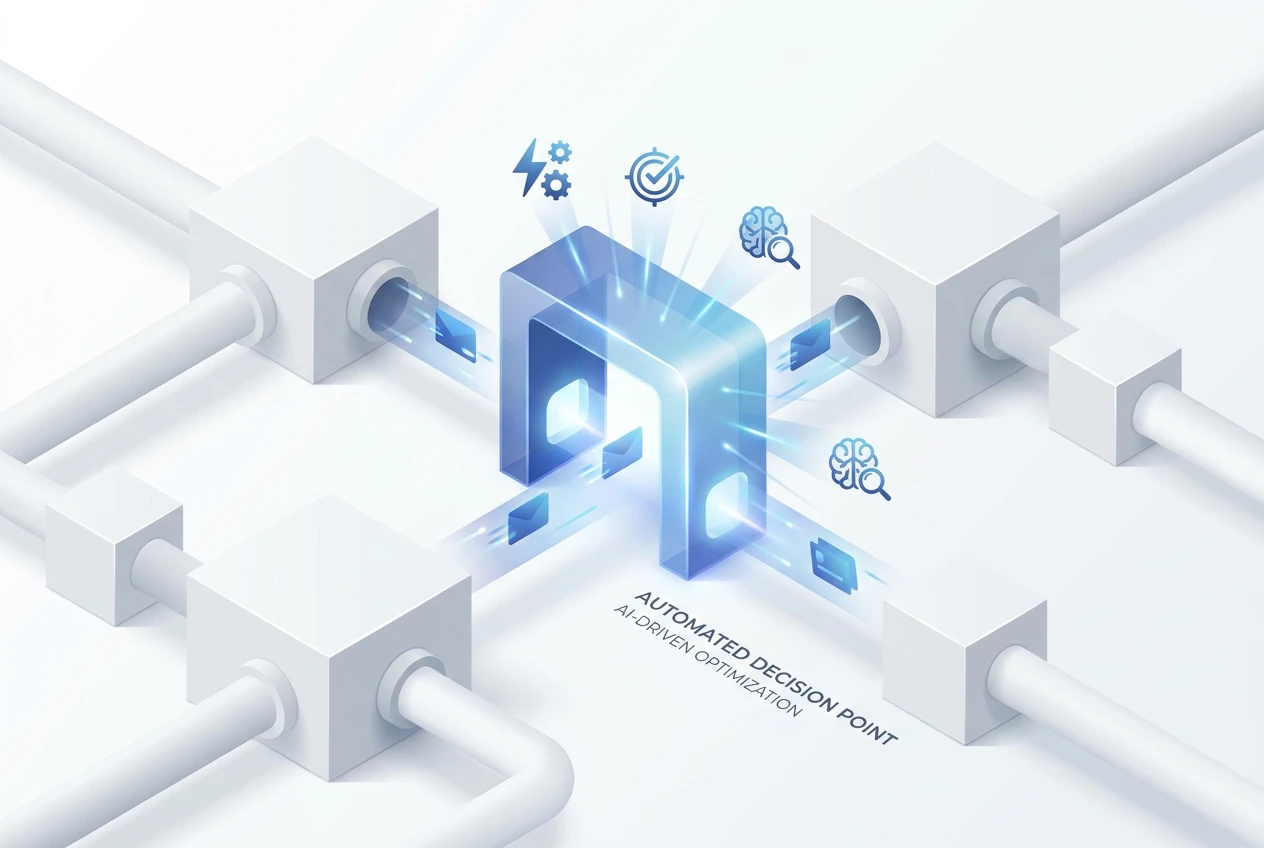
Decision automation, a central component of intelligent workflow automation, involves using artificial intelligence to analyze data and make complex operational decisions independently. It transforms processes by enabling immediate and accurate responses to market fluctuations. Consequently, this shift reduces reliance on human intervention in day-to-day operations. It also allows for a focus on innovation and strategic growth.
What is the difference between task automation and decision automation?
Task automation focuses on repeatedly executing predefined steps. For example, sending an automated email when a form is completed. In contrast, decision automation goes a step further. It uses artificial intelligence to analyze complex scenarios and make the best possible decision based on available data. Therefore, it doesn’t just follow rules—it thinks and adapts.
How does decision automation improve operational processes?
Decision automation improves operational processes through speed and accuracy. Intelligent systems can analyze thousands of data points in seconds. As a result, they can make immediate decisions such as adjusting product prices in response to market demand or rerouting shipments based on weather conditions. This reduces human delays and eliminates errors resulting from manual analysis, significantly boosting efficiency.
What data is needed to implement intelligent workflow automation?
Implementing smart workflow automation requires high-quality, relevant data. This data includes sales records, customer data, inventory levels, and market trends. Additionally, unstructured data such as customer feedback and social media posts can be utilized. The more comprehensive and accurate the data, the better and more effective the decisions made by AI.
Can decision automation be integrated with existing systems?
Yes, absolutely. One of the most important aspects of successful implementation is seamless integration. Solutions like those offered by Lo-ol.AI rely on an integration-first approach. This means that AI agents can connect to your existing enterprise resource planning (ERP), customer relationship management (CRM), and e-commerce platforms. Consequently, the systems you already use are enhanced rather than replaced.
What are the key benefits of decision automation for businesses?
The benefits of decision automation are numerous and include a dramatic improvement in operational efficiency. First, it reduces costs by minimizing the need for manual labor in analytical tasks. Second, it speeds up decision-making, giving the company a competitive edge in rapidly changing markets. Finally, it enables more informed, data-driven decisions, leading to better business outcomes and a measurable return on investment.
How does Lo-ol.AI ensure a tangible return on investment from workflow automation?
At Lo-ol.AI, we focus on delivering measurable ROI. We start by identifying the key processes where automation can have the greatest impact. Next, we develop strategic AI agents custom-designed to solve your business challenges. Furthermore, we track key performance indicators before and after implementation. This approach ensures that every investment in workflow automation translates into real, tangible gains.
Which industries benefit most from decision automation?
Many industries benefit from decision automation. For example, in the retail sector, it can improve inventory management and dynamic pricing. In financial services, it helps assess credit risk and detect fraud. In the logistics sector, it optimizes shipping routes and reduces transportation costs. In short, any company that relies on complex and repetitive operational decisions can achieve tremendous benefits.
What are the first steps toward implementing decision automation?
A successful start requires a clear strategy. Here are the essential steps:
- Define your goals: Clearly define what you want to achieve, such as reducing customer response times or improving inventory management.
- Evaluate data: Ensure you have the necessary and sufficient data to support smart decisions.
- Start with a pilot project: Choose a single high-impact process to kickstart your automation journey. This allows you to prove the concept and measure results.
- Choose the right partner: Partner with an expert like Lowell AI to ensure proper implementation and effective integration.
- Scale and improve: After the pilot project succeeds, expand automation to other operations within the company.
How does business AI go beyond chatbots?
Many believe that business AI is limited to chatbots for customer service. But that’s just the tip of the iceberg. The strategic agents we develop at Lo-ol.AI are far more advanced. They don’t just answer questions; they perform complex tasks across multiple systems. For example, an AI agent can process a product return request, update inventory, schedule shipping, and send a confirmation to the customer—all completely independently.
Frequently Asked Questions
What is decision automation?
It is a technology that uses artificial intelligence to analyze data and make complex operational decisions automatically, reducing the need for human intervention.
Is decision automation suitable for small businesses?
Yes, small and medium-sized businesses can benefit significantly from decision automation. It allows them to compete with larger companies by increasing efficiency and reducing costs.
How long does it take to implement workflow automation solutions?
The timeline depends on the complexity of the process. Simple pilot projects can be implemented within a few weeks, while comprehensive implementations may take several months.
Do I need a large data team to implement these solutions?
Not necessarily. Partners like Lo-ol.AI act as an extension of your team, providing the technical and strategic expertise needed to implement and manage AI solutions.
How is the success of a decision automation project measured?
Success is measured through predefined key performance indicators (KPIs). These metrics may include cost reduction, increased processing speed, improved customer satisfaction, or increased revenue.
What is the difference between artificial intelligence and machine learning?
Artificial intelligence is the broader concept of machines that mimic human intelligence. Machine learning is a branch of artificial intelligence that focuses on training systems to learn from data without explicit programming.
The shift toward intelligent workflow automation is no longer an option, but a strategic necessity. Empowering your company to make faster, smarter decisions is the key to sustainable growth in the digital age. Are you ready to transform your operations and maximize efficiency? Contact the experts at Lowell AI today to explore how our end-to-end AI services can drive your transformation. You can also follow our latest news on Facebook.