
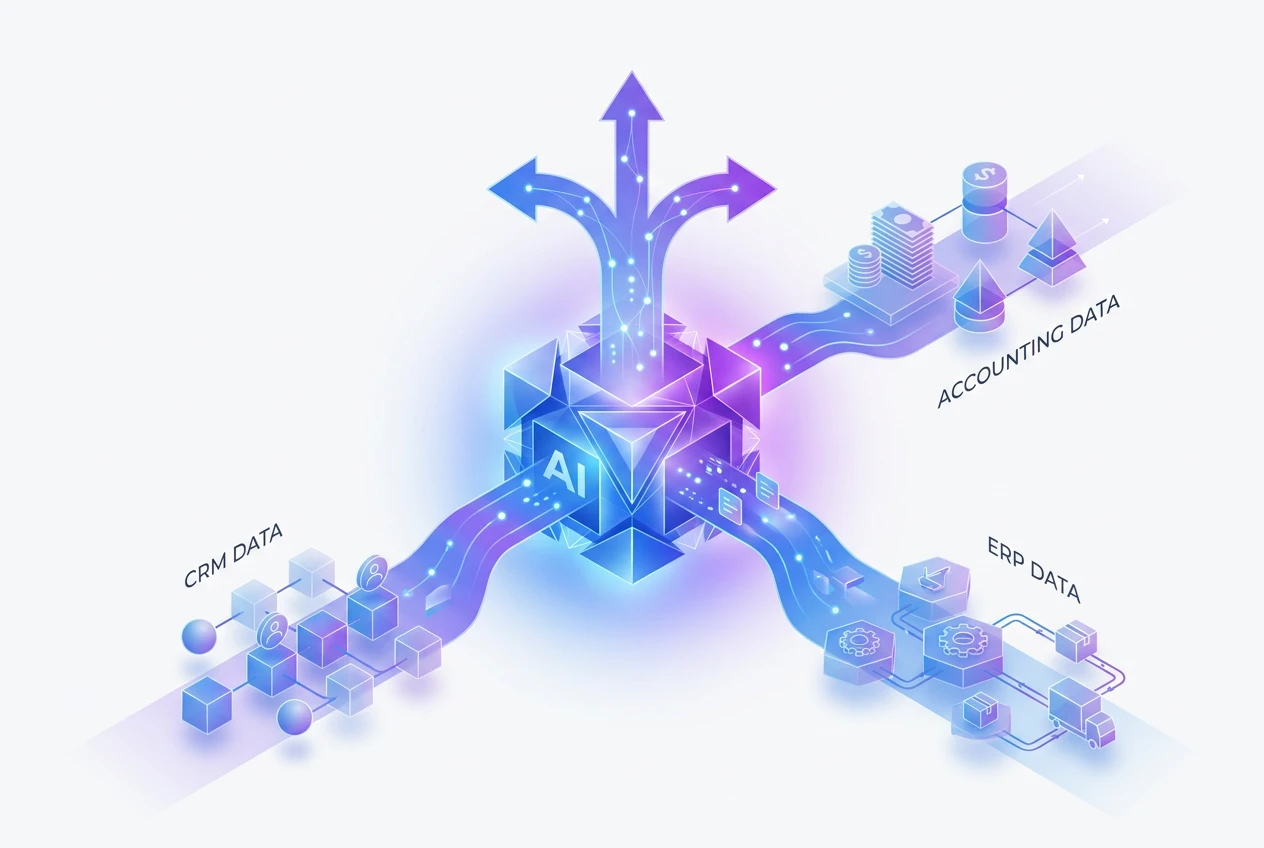
Artificial intelligence uses smart agents to provide intelligent system integration, connecting CRM, ERP, and accounting systems via application programming interfaces (APIs). These agents automate data transfer and synchronization in real time, eliminating the need for manual entry and preventing errors. The result is a unified, accurate data source that provides comprehensive insights for better strategic decision-making and enhances the automation of operational processes.
Why Do Companies Struggle with Siloed Data?
Most companies operate using multiple systems to manage different aspects of their operations. For example, the sales team uses a CRM system, while the finance department relies on accounting software, and operations are managed by an ERP system. These systems often operate independently, creating what are known as “data silos.”
As a result, data becomes fragmented and inconsistent. This disconnection forces employees to spend valuable time manually transferring data between systems, increasing the risk of human error and delaying access to accurate information. The lack of a unified view hinders quick and informed decision-making.
What exactly is intelligent system integration?
Intelligent system integration is an advanced approach that uses artificial intelligence to seamlessly connect different software and applications within an organization. Instead of traditional integration processes that can be rigid and fragile, this approach uses intelligent AI agents to understand the context of data and flexibly coordinate and transfer it between systems.
In short, it is the bridge that connects the isolated data silos within your organization. Therefore, it enables the unification of business data and the creation of a single source of truth. This is essential for achieving operational efficiency and gaining accurate, real-time strategic insights.
How does connecting ERP and CRM systems with AI work?
Integrating ERP, CRM, and accounting systems relies on AI agents that act as intelligent intermediaries. First, these agents are configured to understand the data structures and application programming interfaces (APIs) of each system. Next, the agent monitors changes within a system, such as the addition of a new customer in the CRM.
Immediately, the agent extracts this information, converts it into the required format for the ERP and accounting systems, and then automatically enters it. This process occurs in real time and without any human intervention. Consequently, this automation ensures that all systems are always in sync, eliminating duplication and inconsistencies.
What are the main benefits of unifying business data?
Unifying your business data through intelligent system integration offers tremendous strategic benefits. First and foremost, it provides a comprehensive 360-degree view of the customer and operations. Additionally, it significantly improves decision-making, as managers rely on complete and accurate data.
Other benefits include:
- Increased operational efficiency: By automating data flow between systems, employees are freed from repetitive manual tasks to focus on value-added activities.
- Reduced human error: Automation ensures accurate data transfer, reducing the costs associated with correcting errors.
- Improved customer experience: When customer data is unified, sales and service teams can deliver a personalized and consistent experience.
- Deeper business insights: Combining financial, sales, and operational data allows you to uncover new trends and opportunities.
- Faster market response: Instant access to unified data enables companies to adapt quickly to market changes.
How does Lo-ol.AI’s approach to intelligent system integration differ?
At Lo-ol.AI, we don’t just focus on connecting systems; we focus on building a comprehensive AI strategy that delivers tangible ROI. Our integration-first approach means we view connecting systems as a fundamental step to unlocking the true power of AI.
We use strategic AI agents, not just simple chatbots. These agents are specifically designed to understand your business objectives and automate complex processes from start to finish. As a result, we ensure the solution is scalable and aligned with your long-term goals, giving you a sustainable competitive advantage.
What challenges does AI overcome in integration?
Traditional integration projects face numerous obstacles. For example, differences in data formats, the need for continuous maintenance of connections, and the difficulty of scaling as new systems are added. AI effectively addresses these challenges.
AI agents can handle heterogeneous data structures and translate them dynamically. Furthermore, they can learn and adapt to changes in APIs, reducing the maintenance burden. This flexibility makes CRM, ERP, and accounting integration solutions more robust and scalable.
How do you start implementing enterprise data unification strategies?
Embarking on a data unification journey is easier than you might expect. The first step is to identify key processes that suffer from inefficiencies due to siloed data. For example, the process of transferring a lead from sales to billing.
Next, assess your current systems and identify the critical data points that need to be synchronized. You can then collaborate with a specialized partner like Lowell AI to design and implement a customized, intelligent integration strategy. We help you define clear goals and measure your return on investment through automation.
What is the expected return on investment from this integration?
The return on investment (ROI) from smart system integration is multifaceted. Directly, you’ll see cost savings by reducing manual labor hours and correcting errors. This represents operational automation at its best.
Indirectly, but just as importantly, ROI increases through improved strategic decision-making. When you have a clear view of your business performance, you can identify growth opportunities, optimize resource allocation, and increase revenue. Additionally, improving the customer experience leads to increased customer loyalty and long-term value. You can follow our latest news and tips on our Facebook page.
Frequently Asked Questions
Is the Smart Systems integration process secure?
Yes, security is a top priority. Strong encryption protocols and secure APIs are used to ensure data is protected while in transit between systems. Security best practices are also implemented to control access and prevent any breaches.
How long does it take to implement integration solutions?
The timeline depends on the complexity and number of systems. Simple integrations can take a few weeks, while more comprehensive projects may require a few months. At Lowell AI, we focus on delivering quick, phased results.
Do I need an in-house technical team to manage the integration?
Not necessarily. Our AI agents are designed to operate autonomously with minimal maintenance. At Lowell AI, we provide full support and management as part of our services, allowing you to focus on your core business.
What systems can be integrated?
Almost any system with an API can be integrated. This includes popular CRM systems like Salesforce and HubSpot, ERP systems like SAP and Oracle, accounting software like QuickBooks and Xero, as well as marketing and HR platforms, and more.
How is this different from traditional ETL tools?
Traditional ETL (Extract, Transform, Load) tools typically run on scheduled batches and are rigid. In contrast, intelligent system integration operates in real time, is more flexible and adaptable to changes, and understands the context of the data thanks to artificial intelligence.
Unifying your business data is no longer a luxury—it’s a strategic necessity to stay ahead of the competition. Intelligent system integration allows you to transform your data from a fragmented burden into a powerful asset that drives growth and innovation. Are you ready to unlock the full potential of your data? Contact the experts at Lowell AI today to begin your journey toward intelligent automation.